Could it be said that you are feeling overpowered by the weight of obligation? Could it be said that you are fed up with living paycheck to paycheck, battling to get by? Assuming this is the case, you’re in good company. Many individuals find themselves trapped in the cycle of debt, unable to break free. The good news is that there are fast debt reduction techniques available that can help you get out of debt in record time. In this article, we will explore some fast debt reduction genius tricks that can pave the way to your financial freedom.
Taking Control of Your Finances
Assess Your Current Debt Situation
To begin your journey towards fast debt reduction, it’s essential to have a clear understanding of your current debt situation. Make a rundown of every one of your obligations, including the outstanding equilibriums, loan fees, and least regularly scheduled installments. This assessment will help you prioritize your debts and identify the most effective repayment strategies.
Create a Budget and Stick to It
In order to effectively manage your finances, it is crucial to create a budget. Assess your pay and costs to decide the amount you can assign towards obligation reimbursement. Cut down unnecessary expenses and redirect those funds towards paying off your debts. It’s important to stick to your budget consistently to avoid accumulating more debt.
Prioritize Your Debts
Once you have a comprehensive list of your debts, prioritize them based on factors such as interest rates, outstanding balances, and the impact on your credit score. Consider handling exorbitant premium obligations first to limit how much premium gathering over the long haul. Alternatively, some individuals prefer to start with smaller debts for a psychological boost. Select a method that fits your financial circumstance and encourages you to keep making headway.
To accelerate your debt reduction, look for opportunities to cut expenses and increase your income. Evaluate your monthly expenses and identify areas where you can make cost-saving changes. This could include reducing dining out, canceling unnecessary subscriptions, or downsizing your living arrangements. Additionally, consider taking on a side gig or freelance work to generate extra income that can be directly applied towards debt repayment.
Negotiate with Creditors
Make it a point to contact your banks and haggle better terms. Reach them to talk about choices, for example, lower loan costs, broadened reimbursement plans, or even repayments. Banks are many times ready to work with borrowers who exhibit a veritable obligation to reimbursing their obligations. Arranging might possibly set aside you cash and speed up your excursion towards becoming obligation free.
Consolidate Your Debts
If you’re dealing with various debts, merging them into one through debt consolidation can be a useful solution. Consolidating your debts involves combining all of your outstanding balances into one loan or credit card with a lower interest rate. This can make it easier to manage your finances and pay off your debts faster. This can improve on your reimbursement cycle and possibly lessen your general interest installments. Be that as it may, it’s fundamental to painstakingly audit the agreements of the union’s choice to guarantee it lines up with your monetary objectives.
Assuming that you have exorbitant interest charge card obligation, consider exploiting balance move offers. Many credit card companies provide introductory periods with low or 0% interest rates on balance transfers. One way to reduce credit card debt and pay it off quicker is by transferring the balance to a card with a lower interest rate. Over time, this could assist in reducing your interest payments and saving money.
Consider Debt Snowball or Debt Avalanche Methods
Two common ways to reduce debt are the debt snowball and debt avalanche methods. A strategy that can effectively manage debt is the snowball method. This technique prioritizes paying off the smallest debt initially, while continuing to make minimum payments on other debts. When the littlest obligation is paid off, you continue on toward the following littlest obligation. The obligation torrential slide strategy, then again, focuses on obligations with the most elevated loan fees. Both of these methods have their own advantages, and it is up to you to decide which one fits your financial objectives and inspires you to keep moving forward.
Bankrate provides a comprehensive guide on how to pay off debt, including the debt snowball and debt avalanche methods.
Seek Professional Help
If you’re finding it challenging to handle things independently, it’s wise to consider seeking guidance from a qualified professional. Credit counseling agencies and financial advisors can provide personalized guidance and debt management plans tailored to your specific situation. A debt settlement company can act as your representative and negotiate with your creditors to help you achieve financial independence. Additionally, they can offer useful advice to assist you in navigating the process.
Stay Committed and Motivated
Reducing debt requires discipline and commitment. Stay motivated by regularly reminding yourself of the benefits of becoming debt-free. Put forth sensible objectives and keep tabs on your development en route. Celebrate milestones to maintain your enthusiasm and reinforce positive financial habits.
Celebrate Small Victories
Paying off debt is a significant achievement, no matter the amount. Celebrate each milestone along your journey to debt freedom. Whether it’s paying off a credit card or reaching a specific balance reduction, reward yourself for your hard work. Encouragement can be a powerful tool to keep you motivated and dedicated to achieving your goal of reducing your debt.
Avoid Accumulating New Debt
While working towards paying off your existing debt, it’s crucial to avoid accumulating new debt. It is advisable to cultivate healthy financial practices, like opting for cash or debit cards over credit cards when making purchases. Make sure to live within your means and resist the temptation of unnecessary spending.
Build an Emergency Fund
Creating an emergency fund is a crucial aspect of debt reduction and financial stability. Set aside a portion of your income into a separate savings account to cover unexpected expenses. It’s important to have an emergency fund in case unexpected situations occur. This way, you can avoid having to use credit cards or taking on extra debt.
The Balance offers a detailed guide on how to reduce or eliminate debt, including the importance of building an emergency fund.
CuraDebt: A top-rated debt relief agency that specializes in assisting individuals in achieving peace of mind concerning their debts. They offer free consultations, with no upfront fees or obligations. Their services focus on debt settlement and relief, helping individuals negotiate with lenders and handle outstanding loans and tax bills. They claim that clients who stick with their program and settle all their debts realize approximate savings of 50% before fees or 30% including their fees over a period of 24 to 48 months. However, it’s worth noting that not all debts are eligible for enrollment, and not all clients complete the program.
Educate Yourself on Personal Finance
Take the time to educate yourself on personal finance and debt management strategies. Read books, attend workshops, and follow reputable financial experts who provide valuable insights. By acquiring knowledge, you can improve your ability to make wise financial choices and lead a life free from debt.
Fast debt reduction is possible with the right strategies and mindset. By assessing your debt situation, creating a budget, prioritizing your debts, and employing various debt reduction techniques, you can take control of your finances and work towards a debt-free future. Remember to stay committed, celebrate your achievements along the way, and make conscious choices to avoid accumulating new debt.
Frequently Asked Questions
Q: How long will it take to become debt-free using these techniques?
A: The timeline for becoming debt-free varies depending on the amount of debt, your income, and the strategies you employ. With consistent effort and discipline, you can significantly reduce your debt within a few years.
Q: Should I pay off high-interest debt first or focus on smaller debts?
A: Both approaches have their advantages. Paying off high-interest debt first saves you more money in the long run, while paying off smaller debts provides psychological motivation. Set realistic goals and choose a method that aligns with your financial goals and motivates you to stay on track.
Q: Is debt consolidation a good option for everyone?
A: Debt consolidation can be beneficial for individuals with multiple high-interest debts. It is important to thoroughly examine the terms and fees of consolidation choices before moving forward.
Q: Can I negotiate with creditors on my own?
A: Yes, you can negotiate with creditors on your own. Contact them to discuss options such as interest rate reductions or extended repayment plans. Be prepared to demonstrate your commitment to repaying your debts.
Q: What should I do if I can’t manage my debt on my own?
A: If you’re struggling to manage your debt, consider seeking professional help from credit counseling agencies or financial advisors. They can provide personalized guidance and debt management plans tailored to your specific needs.
In the digital age, businesses have realized the paramount importance of effective communication with their audience. Email marketing has become a potent instrument for connecting with potential clientele and nurturing long-term connections with current ones. Constant Contact has been a notable player in the email marketing arena, catering to the needs of businesses both big and small. In this article, we will delve into the features, pros, and cons of Constant Contact, providing you with an unbiased review to help you make an informed decision for your marketing endeavors.
What is Constant Contact?
Constant Contact is an all-in-one email marketing platform that has been a prominent player in the industry for many years. Founded in 1995, the platform has garnered a wealth of experience and served millions of customers worldwide. This tool is crafted to make the task of creating, managing, and optimizing email campaigns a breeze. It is a perfect solution for businesses of any size.
The Importance of Email Marketing
Engaging with your audience through email marketing remains one of the most effective and direct methods. With a well-curated email list, businesses can communicate their latest products, promotions, and news directly to their subscribers’ inboxes. This targeted approach allows for personalized content delivery, enhancing the chances of capturing the recipients’ attention and driving action.
Furthermore, email marketing is highly measurable, providing valuable insights into campaign performance. Businesses can use metrics like open rates, click-through rates, and conversion rates to assess the success of their email campaigns and implement changes based on the data.
Constant Contact: A Brief History
Constant Contact’s journey began in 1995 when it was founded as “Roving Software Inc.” in Massachusetts, USA. Initially, the company focused on developing email marketing tools for small businesses. As the demand for email marketing solutions grew, Roving Software Inc. rebranded itself as “Constant Contact” in 2004 to better reflect its core services.
Over the years, Constant Contact expanded its offerings, adding features beyond email marketing, such as contact management, automation, and reporting. Today, the platform stands as a comprehensive solution for businesses seeking to streamline their marketing efforts through email communication.
Overview of Constant Contact’s Services and Features
Constant Contact boasts a wide range of services and features designed to empower businesses to execute successful email marketing campaigns. Here are some of its key offerings:
Email Marketing: Constant Contact provides an intuitive drag-and-drop editor, enabling users to create visually appealing emails without any coding knowledge. The platform offers a vast selection of customizable templates to suit various industries and marketing goals.
Contact Management: Efficiently managing contact lists is made simple with Constant Contact. Users can import contacts from different sources, segment them into specific groups, and maintain a well-organized database.
List Segmentation: This powerful feature allows businesses to divide their subscriber base into targeted segments based on criteria like location, interests, or engagement level. Segmentation enables personalized content delivery, increasing engagement and conversion rates.
Automation: Constant Contact offers automation tools to save time and effort on manual tasks. Users can set up automated welcome emails, drip campaigns, and personalized follow-ups, ensuring timely and relevant communication with subscribers.
Reporting and Analytics: Constant Contact offers comprehensive reports and analytics to evaluate the success of email campaigns. Users can track important metrics to identify trends, strengths, and areas for improvement.
Purpose of the Review
The purpose of this review is to provide businesses with an unbiased assessment of Constant Contact as an email marketing tool. By understanding its features, pros, and cons, businesses can determine whether Constant Contact aligns with their marketing objectives. Our aim is to equip readers with the information they need to make an informed decision about integrating Constant Contact into their marketing strategies
Detailed Review of Constant Contact
Constant Contact has been a stalwart in the email marketing realm for decades, catering to the needs of businesses seeking to bolster their communication strategies. In this detailed review, we will explore various aspects of Constant Contact, ranging from its user interface and ease of use to its email templates, automation features, contact management, reporting capabilities, integration options, and customer support.
User Interface and Ease of Use
Constant Contact prides itself on its user-friendly interface, making it accessible to both seasoned marketers and beginners alike. Navigating through the platform is a breeze, with intuitive menus and clear instructions at every step. The dashboard presents a comprehensive overview of your campaigns, contacts, and performance metrics, allowing for quick and efficient management of your email marketing endeavors.
Email Templates and Customization Options
When it comes to email templates, Constant Contact offers a diverse array of professionally designed options. Whether you’re promoting a product, announcing an event, or sending out a newsletter, you’ll find a template that suits your needs. Each template is fully customizable, enabling users to tailor the content, colors, and visuals to match their brand identity. Additionally, the drag-and-drop editor simplifies the customization process, eliminating the need for coding skills.
Email Automation Features
Constant Contact’s email automation features streamline the process of engaging with subscribers. Users can create automated email sequences based on various triggers, such as new sign-ups, birthdays, or specific actions taken by the recipients. From welcome emails to abandoned cart reminders, the automation capabilities of Constant Contact help nurture leads and maintain consistent communication with your audience.
Efficient contact management is essential for successful email marketing, and Constant Contact excels in this aspect. Users can easily import contacts from various sources, including spreadsheets, Gmail, and Outlook. With this platform, it’s easy to integrate with e-commerce platforms such as Shopify. The integration enables customer data to sync automatically, making your job seamless.
Moreover, Constant Contact’s segmentation options empower businesses to divide their subscriber list into targeted groups based on demographics, purchase history, engagement, and more. By sending personalized content to specific segments, businesses can significantly improve engagement and conversion rates.
Reporting and Analytics
Constant Contact provides comprehensive reporting and analytics tools to gauge the effectiveness of email campaigns. Users can track critical metrics like open rates, click-through rates, bounce rates, and unsubscribe rates. This data offers valuable insights into subscriber behavior and helps identify the most engaging content. Armed with this information, businesses can fine-tune their email strategies for optimal results.
Constant Contact offers seamless integration with a wide range of third-party platforms, enabling users to enhance their email marketing efforts. Whether it’s integrating with e-commerce platforms, CRM systems, or social media platforms, Constant Contact ensures that businesses can consolidate their marketing tools and data for more effective campaigns.
Customer Support
Constant Contact takes pride in its robust customer support. Users can access a variety of resources, including guides, video tutorials, webinars, and an extensive knowledge base. The support team is readily available to address any inquiries or issues that users may encounter. Additionally, Constant Contact offers phone support during business hours, ensuring that users can receive prompt assistance when needed.
Pros and Cons of Constant Contact
Constant Contact has established itself as a reputable email marketing platform, catering to businesses of all sizes. Like any tool, it comes with its own set of advantages and areas for improvement. Let’s take a look at the advantages and drawbacks of utilizing Constant Contact as well as compare it to other well-known email marketing tools such as Mailchimp, Sendinblue, and GetResponse.
Advantages of Using Constant Contact
User-Friendly Interface: Constant Contact boasts an intuitive and easy-to-navigate interface, allowing users to quickly create and manage email campaigns without a steep learning curve.
Diverse Email Templates: The platform offers a wide range of professionally designed templates, enabling businesses to create visually appealing emails that align with their brand identity.
Powerful Automation: Constant Contact’s automation features streamline email marketing efforts, helping users set up personalized and timely email sequences to engage subscribers.
Effective Contact Management: Managing contacts is made simple, with options to import lists from various sources and segment subscribers based on specific criteria.
Comprehensive Reporting: Users gain valuable insights into their campaigns through detailed reporting and analytics, enabling data-driven decisions for optimization.
Seamless Integrations: Constant Contact integrates with numerous third-party platforms, allowing businesses to consolidate their marketing tools for enhanced efficiency.
Excellent Customer Support: The platform provides robust customer support, including guides, video tutorials, webinars, and phone assistance during business hours.
Areas for Improvement
Pricing: Some users find Constant Contact’s pricing to be slightly higher compared to other email marketing platforms, especially for businesses on a tight budget.
Limited Automation in Basic Plans: Certain advanced automation features are restricted to higher-priced plans, which may limit options for users on lower-tier plans.
Template Customization Limitations: While Constant Contact offers diverse templates, some users may find the customization options to be somewhat restrictive.
● Ease of Use: Both Constant Contact and Mailchimp offer user-friendly interfaces, making them suitable for beginners.
● Email Templates: Constant Contact provides a wider variety of templates, while Mailchimp offers more flexibility for customization.
● Automation: Constant Contact may have more robust automation features in its higher-tier plans, whereas Mailchimp offers more extensive automation options for all plan levels.
● Contact Management: Both platforms offer efficient contact management and segmentation capabilities.
● Pricing: Constant Contact’s pricing may be higher than Mailchimp’s, especially for larger contact lists.
● Email Templates: Constant Contact has a more extensive library of templates, but GetResponse offers advanced customization options.
● Automation: Both platforms offer powerful automation features, though the specific capabilities may vary.
● Pricing: Constant Contact’s pricing might be higher, particularly for larger subscriber lists, while GetResponse may offer more affordable options.
● Contact Management: Both platforms provide efficient contact management tools and list segmentation.
● Reporting: Both platforms offer detailed reporting and analytics to track campaign performance.
Pricing
Detailed Explanation of Constant Contact’s Pricing Plans
Constant Contact offers flexible pricing plans to accommodate businesses of all sizes and needs. The platform provides two main pricing models: Email and Email Plus.
Email: This plan is suitable for businesses starting with email marketing or those with a smaller contact list. Pricing is based on the number of contacts, and subscribers can send unlimited emails per month. Additional features include customizable templates, automation, contact management, reporting, and access to customer support.
Email Plus: This plan is designed for businesses with more advanced email marketing requirements. In addition to all the features offered in the Email plan, Email Plus includes advanced automation, A/B testing, event marketing, and enhanced e-commerce features. Pricing is also based on the number of contacts.
With Constant Contact, you can take advantage of a 60-day free trial for both of their plans. You have the chance to thoroughly test out all the features and capabilities of the platform before committing to a subscription.
Value for Money Assessment
Constant Contact’s pricing aligns with its feature set, providing users with a comprehensive email marketing solution. The platform’s user-friendly interface, diverse email templates, powerful automation, contact management tools, and reporting capabilities contribute to its value for money proposition. For businesses seeking to establish effective email campaigns with ease, Constant Contact’s pricing plans offer an attractive balance of features and affordability.
Customer Testimonials
Share Some Customer Testimonials and Reviews about Constant Contact
Sarah Jennings, Marketing Director, HomeStyle Retailers: “Constant Contact has been a game-changer for our business. The intuitive interface and ready-to-use templates helped us quickly create engaging email campaigns. The automation features have saved us time and allowed us to stay connected with our customers effortlessly.
Highly recommended!”
Johnathan Li, Fundraising Coordinator, GreenFuture Nonprofit:“We switched to Constant Contact after struggling with another platform. The contact management and segmentation options have been invaluable for tailoring our messages to specific donor groups. The reporting tools have given us valuable insights into our campaign performance. Fantastic platform!”
Emily Torres, Events Manager, CelebrateNow Event Planning: “Constant Contact’s customer support team is top-notch! Whenever we faced any challenges or had questions, they were always there to assist us promptly. The platform’s features and integration capabilities have helped us streamline our event marketing efforts. It’s been a fantastic experience.”
Conclusion
Constant Contact is a reliable and easy-to-use email marketing platform that caters to businesses of any size. With its intuitive interface, diverse templates, powerful automation, and efficient contact management, Constant Contact empowers users to create engaging and targeted email campaigns. The platform’s value for money proposition, coupled with its robust customer support, makes it a solid choice for businesses seeking to excel in their email marketing endeavors.
A: Yes, Constant Contact is an excellent choice for beginners. Its user-friendly interface and intuitive drag-and-drop editor make it easy for newcomers to create and manage email campaigns without technical expertise.
Q: How Does Constant Contact Compare to Other Email Marketing Tools?
A: Constant Contact competes well with other email marketing tools. Its strengths lie in its user-friendly interface, diverse templates, automation features, and seamless integrations. While pricing may be slightly higher in some cases, it offers a robust solution for businesses seeking a comprehensive email marketing platform.
Q: What Kind of Customer Support Does Constant Contact Offer?
A: Constant Contact provides robust customer support, including guides, video tutorials, webinars, and phone assistance during business hours. Their support team is readily available to address inquiries and offer assistance.
Q: Is Constant Contact Worth the Price?
A: Considering its features, ease of use, and customer support, Constant Contact offers good value for money for businesses seeking an efficient and reliable email marketing platform.
Q: Can You Integrate Constant Contact with Other Platforms?
A: Yes, Constant Contact offers seamless integration with various third-party platforms, allowing businesses to enhance their email marketing efforts by consolidating their marketing tools.
Artificial Intelligence (AI) has revolutionized various industries, and content creation is no exception. With the advancement of AI technology, content generation has become more efficient, enabling businesses and individuals to produce high-quality content at scale. This guide is a comprehensive and in-depth exploration of the best AI content generation tools available in 2023 and how they can empower you to create compelling and engaging content. So, let’s dive in and unleash the power of AI!
Understanding AI Content Generation
What is AI content generation?
Content generation through AI involves using algorithms and machine learning to produce written or visual content. These advanced tools analyze data, patterns, and user preferences to generate high-quality content that mimics human-like writing.
How does AI content generation work?
AI-based content generators utilize NLP and machine learning algorithms to create text through natural language processing. They are trained on vast amounts of existing content, enabling them to understand language patterns, context, and grammar rules. These tools can then produce original content based on user input or specific parameters provided.
The benefits of using AI for content generation
Enhanced Efficiency: AI content generation tools can produce a large volume of content in a short amount of time. This significantly improves efficiency and saves valuable resources for businesses and content creators.
Consistency: AI-generated content ensures consistency in tone, style, and messaging. It eliminates the variations that may arise when multiple writers are involved, maintaining a unified voice across all content pieces.
Cost-Effective: Hiring professional content writers can be expensive, especially for long-term content needs. AI content generation tools offer a cost-effective alternative without compromising on quality.
Time-Saving: Content creation can be time-consuming, requiring extensive research and planning. AI tools can automate the content generation process, freeing up time for writers to focus on other essential tasks.
Improved SEO: AI content generation tools can integrate SEO optimization techniques into content creation. They can identify relevant keywords, generate meta descriptions, and craft compelling headlines to boost search engine visibility.
Versatility: AI content generation tools can create content in various formats, including blog posts, social media updates, product descriptions, and more. This versatility allows businesses to cater to different platforms and audiences effectively.
Pricing Information
TextBuilder.ai offers a variety of pricing options to cater to different needs. They have a unique system where 1 credit equals 1 word, allowing you to control how much content you generate. As a new user, you’re given 1000 credits to try out the application.
Lifetime Deal
The Lifetime Deal is currently priced at $79. This deal is perfect for those who wish to make a one-time payment and enjoy the benefits of the tool indefinitely.
Monthly Credits
TextBuilder.ai offers several packages with varying amounts of monthly credits:
50,000 Monthly Credits: This package costs $59 and is currently limited to 84 deals. It’s estimated to generate around 50 articles or 2-3 blogs monthly, potentially yielding a monthly profit of $30-300.
100,000 Monthly Credits: Priced at $99, this package is limited to 5 deals. It’s estimated to generate around 100 articles or 5-6 blogs monthly, potentially yielding a monthly profit of $60-600.
500,000 Monthly Credits: This package costs $395 and is limited to 8 deals. It’s estimated to generate around 500 articles or 25-30 blogs monthly, potentially yielding a monthly profit of $300-2500.
1,000,000 Monthly Credits: The most extensive package costs $795 and is limited to 7 deals. It’s estimated to generate around 1000 articles or 50-70 blogs monthly, potentially yielding a monthly profit of $600-5000.
All credits are stackable, meaning you can buy as many as you want. These credits will be added to your existing plan and will renew every month.
Unlock All Features
For professionals who write a lot and need access to all AI tools, as well as all future updates, TextBuilder.ai offers advanced plans:
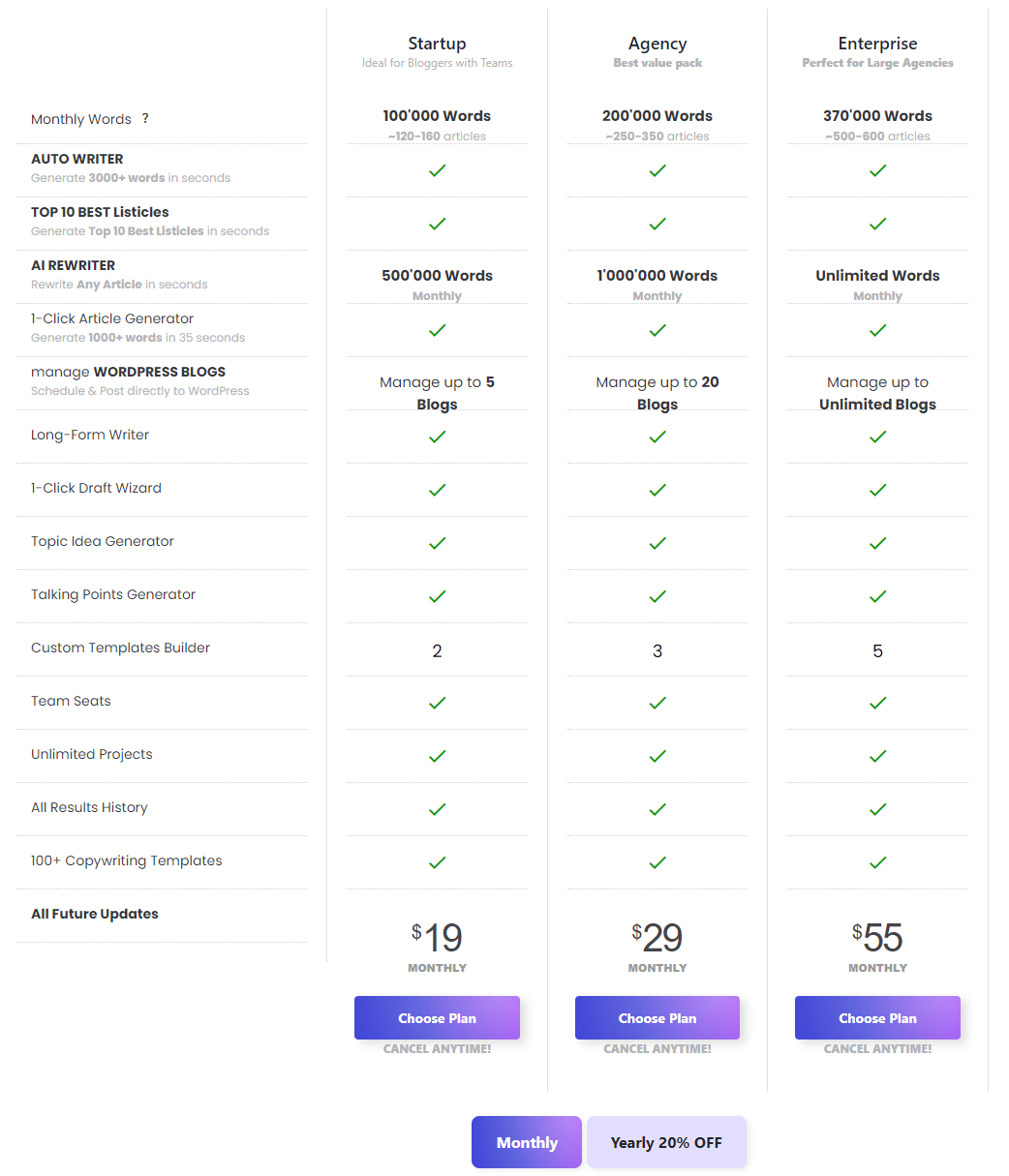
Startup: Ideal for bloggers with teams, this plan costs $19 monthly and provides 100,000 words (~120-160 articles).
Agency: This value pack costs $29 monthly and provides 200,000 words (~250-350 articles).
Enterprise: Perfect for large agencies, this plan costs $55 monthly and provides 370,000 words (~500-600 articles).
All these plans come with a host of features, including Auto Writer, AI Rewriter, 1-Click Article Generator, WordPress Blog Management, Long-Form Writer, and more.
The Top AI Content Generation Tools
AI content generation tools have revolutionized the way we create written content. They provide an efficient and effective solution for businesses, marketers, and content creators looking to generate high-quality content at scale. In this article, we will explore one of the top AI content generation tools, TextBuilder.ai, and its features and benefits. We will also compare it with other leading tools in the market.
In today’s digital age, the demand for content is higher than ever. Whether it’s blog posts, articles, product descriptions, or social media captions, businesses need to produce a significant amount of content to engage their target audience. This is where AI content generation tools come into play, offering a time-saving and efficient solution.
TextBuilder.ai is one of the leading AI content-generation tools available in the market. It utilizes state-of-the-art natural language processing algorithms to create high-quality content quickly. This platform offers a user-friendly interface that makes it easy to create various types of content, including articles, blog posts, and social media content.
TextBuilder.ai provides several notable features and benefits that make it stand out from the competition:
Versatile Content Generation
With TextBuilder.ai, you can generate various types of content to suit your needs. Whether you require a persuasive sales copy, an informative blog post, or a creative social media caption, this tool can generate it all.
Customizable Outputs
Users can customize the generated content based on their preferences using the tool. You can specify the tone, style, and length of the content, ensuring it aligns perfectly with your brand voice and requirements.
SEO Optimization
TextBuilder.ai incorporates SEO optimization techniques to ensure that the generated content is search-engine friendly. It helps improve your website’s visibility and organic traffic by creating content that aligns with relevant keywords and follows SEO best practices.
Time and Cost Efficiency
By automating the content generation process, TextBuilder.ai saves valuable time and reduces costs associated with hiring freelance writers or content agencies. It allows you to generate content on-demand, eliminating the wait time and delays often associated with traditional content creation methods.
Standing Out from the Competition
TextBuilder.ai stands out from its competitors due to its advanced AI algorithms and user-friendly interface. The platform utilizes cutting-edge language models to generate content that closely resembles human-written text. Its intuitive interface makes it easy for both experienced writers and novices to create compelling content effortlessly.
Overview and Comparison of Other Top AI Content Generation Tools
While TextBuilder.ai is an excellent AI content generation tool, it’s also essential to consider other alternatives. Here is a brief overview and comparison of some other top AI content generation tools in the market:
ContentBot: ContentBot is known for its extensive database of writing templates, allowing users to generate content in various formats quickly. It offers various pre-defined templates for blog posts, social media content, email newsletters, and more.
Copy.ai: Copy.ai specializes in creating persuasive and engaging sales copies. It uses AI algorithms to analyze consumer behavior and generate content that drives conversions and sales.
ArticleForge: ArticleForge is a popular tool for generating SEO-optimized articles. It leverages AI to gather information from reliable sources and creates comprehensive and informative articles on any given topic.
Jasper: Jasper is a highly adaptable content generation tool powered by AI. It can produce various types of content like blog posts, social media captions, video scripts, and many more. The interface is designed to be easy to use, and it can be used in various languages.
Writesonic: Writesonic is known for its AI-powered copywriting capabilities. It can generate attention-grabbing headlines, product descriptions, and persuasive ad copies that resonate with your target audience.
How to Choose the Best AI Content Generation Tool
In today’s digital age, AI content generation tools have become indispensable for businesses and content creators. These tools leverage artificial intelligence and natural language processing to automate the process of creating engaging and high-quality content.
However, with the wide range of options available in the market, it can be challenging to choose the best AI content generation tool that suits your specific needs. In this guide, we’ll go over the important factors to keep in mind when choosing an AI content-generation tool and explain why TextBuilder.ai could be the best choice for most users.
Factors to Consider when Choosing an AI Content Generation Tool
Accuracy and Quality: The primary goal of using an AI content generation tool is to produce high-quality content. Look for a tool that consistently generates accurate and coherent articles, ensuring that the output aligns with your requirements and standards.
Ease of Use: Choose a tool that is user-friendly and intuitive. It should have a simple interface and offer a smooth writing experience, allowing you to generate content efficiently without any technical hassles.
Versatility: Consider the versatility of the AI content generation tool. Search for a versatile tool that can create multiple forms of content. This includes blog posts, social media captions, product descriptions, and additional options. This ensures that you can use the tool for multiple purposes and across different platforms.
Customization Options: A good AI, content generation tool, should provide customization options to tailor the generated content according to your brand’s voice and style. Look for tools that allow you to set parameters, such as tone, word count, and keyword inclusion, to ensure the content aligns with your specific requirements.
Language Support: If you operate in multiple languages or target a global audience, ensure that the AI content generation tool supports the languages you require. It should have a robust language model that can generate accurate content in various languages.
Integration and Compatibility: Consider the tool’s integration capabilities with other platforms and content management systems. Ensure that the tool seamlessly integrates with your existing workflow and provides compatibility with the platforms you use.
Customer Support: Evaluate the level of customer support provided by the AI content generation tool’s company. If you encounter any technical problems or have questions, our support team is available to provide prompt assistance and ensure that your experience is seamless.
Why TextBuilder.ai could be the Best Choice for Most Users
TextBuilder.ai stands out as an exceptional AI content generation tool due to its advanced features and user-centric approach. Here’s why TextBuilder.ai could be the best choice for most users:
Advanced AI Technology: TextBuilder.ai utilizes state-of-the-art natural language processing models, enabling it to generate content that is highly accurate, coherent, and contextually relevant. Its advanced algorithms ensure that the generated content meets professional standards.
User-Friendly Interface: TextBuilder.ai boasts an intuitive and user-friendly interface, making it accessible to both beginners and experienced users. Its simple layout and easy navigation allow users to quickly generate engaging content without any technical expertise.
Versatile Content Generation: Whether you need blog posts, social media content, or product descriptions, TextBuilder.ai has got you covered. It offers a wide range of content generation options, catering to various business needs and marketing strategies.
Extensive Customization: TextBuilder.ai provides extensive customization options, allowing users to define the tone, style, word count, and other parameters for the generated content. This ensures that the content aligns perfectly with your brand’s identity and specific requirements.
Multi-Language Support: TextBuilder.ai supports multiple languages, making it an excellent choice for businesses with a global reach. Its language model can generate content in various languages accurately, helping you connect with your target audience effectively.
Seamless Integration: TextBuilder.ai seamlessly integrates with popular platforms and content management systems, enabling smooth collaboration and workflow integration. Whether you use WordPress, Shopify, or other platforms, TextBuilder.ai adapts to your existing infrastructure.
Dedicated Customer Support: TextBuilder.ai offers excellent customer support, ensuring that users receive prompt assistance when needed. Their support team is responsive and knowledgeable, resolving any queries or concerns efficiently.
Maximizing the Use of AI Content Generation Tools
Tips and Strategies for Getting the Most out of AI Content Generation Tools
Understand the Tool’s Capabilities: Take the time to explore and understand the features and capabilities of your chosen AI content generation tool. Familiarize yourself with its customization options, supported content types, and any limitations it may have.
Set Clear Objectives: Clearly define your content objectives and goals before using an AI content generation tool. Determine the purpose, target audience, and key messages you want to convey through the generated content.
Provide Guidance and Feedback: While AI content generation tools can produce impressive results, they still benefit from human guidance. Provide initial input and guidance to the tool, and review and provide feedback on the generated content to improve its accuracy and relevance.
Edit and Refine: The content generated by AI tools may require some editing and refining to match your specific needs. Polish the content, check for grammar and spelling errors, and ensure it aligns with your brand’s voice and style.
Supplement with Human Touch: While AI-generated content can be a valuable asset, don’t solely rely on it. Supplement it with human-written content to add a personal touch, creativity, and unique insights to your articles and other content pieces.
One success story of using TextBuilder.ai comes from a digital marketing agency called XYZ Solutions. They were struggling to keep up with the demand for high-quality blog content for their clients. By implementing TextBuilder.ai into their content creation process, they were able to significantly reduce the time and effort spent on writing blog posts while maintaining a consistent level of quality.
TextBuilder.ai’s customization options allowed XYZ Solutions to tailor the content to each client’s specific needs and brand guidelines. The agency also appreciated the versatility of the tool, as it could generate content across various industries and topics. With the seamless integration of TextBuilder.ai into their existing workflow, XYZ Solutions experienced a boost in productivity and client satisfaction.
TextBuilder.ai is an advanced AI-powered platform designed to generate high-quality content automatically. It utilizes state-of-the-art natural language processing algorithms and machine-learning techniques to produce human-like articles, blog posts, product descriptions, and more. With TextBuilder.ai, you can save time and effort by automating the content creation process while maintaining control over the final output.
TextBuilder.ai employs a combination of deep learning models and large-scale language models to generate content. It uses sophisticated algorithms to analyze and understand the input prompt, allowing it to generate contextually relevant and coherent text. By learning from vast amounts of existing data, TextBuilder.ai can mimic the style and tone of human-written content, producing articles that are indistinguishable from those written by human writers.
How can TextBuilder.ai generate 5000+ articles with one click?
TextBuilder.ai’s powerful algorithms enable it to generate a large volume of articles with just a single click. By utilizing its vast knowledge base and language models, TextBuilder.ai can produce multiple variations of an article based on the provided input. This feature is particularly useful for content marketers, bloggers, and businesses looking to create a diverse range of articles for their websites or publications.
TextBuilder.ai caters to a wide range of users who require high-quality written content. Bloggers, content marketers, copywriters, and businesses in need of regular content updates can greatly benefit from TextBuilder.ai’s capabilities. It saves time, reduces costs, and ensures consistent content output, allowing users to focus on other aspects of their business.
Can TextBuilder.ai be used to generate a FAQ section for articles?
Yes, TextBuilder.ai is an excellent tool for generating FAQ sections for articles. By providing the necessary questions and answers, TextBuilder.ai can quickly produce a comprehensive FAQ section that adds value to your content. This particular feature could be particularly useful for businesses and websites that wish to provide informative and user-friendly articles in addition to well-organized FAQs.
What are the templates available in TextBuilder.ai for generating FAQs?
TextBuilder.ai offers a variety of pre-designed templates specifically tailored for generating FAQs. These templates ensure that your FAQ section is well-organized, easy to read, and visually appealing. With TextBuilder.ai, you can choose from different question-and-answer formats, customize the styling, and create a professional-looking FAQ section effortlessly.
Yes, TextBuilder.ai provides a Lifetime Deal option for its users. The Lifetime Deal offers users the opportunity to access the platform’s features and benefits without any recurring monthly or annual costs. It’s a one-time payment that grants lifetime access to TextBuilder.ai, allowing you to generate high-quality content whenever you need it.
The pricing details of TextBuilder.ai’s Lifetime Deal can be found on their official website. The cost may vary depending on the specific plan and features you choose. It’s recommended to visit the website or contact the TextBuilder.ai team directly for accurate and up-to-date pricing information.
How many words per month does the TextBuilder.ai LifeTime Deal offer?
The number of words per month included in the TextBuilder.ai LifeTime Deal may vary depending on the plan you select. TextBuilder.ai offers different subscription tiers, each with its own word limit. It’s advisable to review the available plans and associated word limits on their website to determine the most suitable option for your content generation needs.
How can TextBuilder.ai be used to improve the structure and readability of an article?
TextBuilder.ai excels in enhancing the structure and readability of articles. By providing the initial outline or main points, TextBuilder.ai can generate well-structured paragraphs that engage the reader. It ensures the logical flow of information and produces content that is easy to read and comprehend. Additionally, the platform’s language models help optimize sentence structure, grammar, and overall coherence, resulting in highly polished and professional content.
Conclusion
AI content generation tools have revolutionized the way content is created. They offer numerous benefits, including increased efficiency, consistency, and cost savings. With tools like GPT-3, ContentBot, Copywriter, WordSmith, and Jarvis, content creators can unlock their creative potential and produce engaging content at scale. However, ethical considerations and human oversight remain essential to ensure the responsible use of AI in content generation.
Sign Up Today!
Ready to enhance your content strategy with TextBuilder.ai? Sign up now and unlock the power of AI content generation. Experience improved efficiency, superior content quality, and increased productivity. Don’t miss out on the opportunity to take your content creation to new heights.
Financial freedom may seem like a lofty goal, but it’s more attainable than you might think. With discipline, knowledge, and a well-thought-out plan, you can navigate the road to financial freedom. This blog post will provide you with the necessary strategies, facts, and tips to achieve this independence.
Understand Your Financial Situation
The first step towards financial freedom is to have a clear understanding of your current financial situation. This involves analyzing your income, expenses, debts, and assets. Regular financial check-ups, just like health check-ups, are crucial to keep track of your financial health. Here are a few interesting facts to keep in mind:
Fact: The average debt for an American household, including mortgages, student loans, and credit card balances, is $96,371. (source: Bankrate 2023).
To begin, create a detailed budget by listing all your sources of income and itemizing your monthly expenses. Make sure to include both essential and discretionary expenses. This will give you a clear picture of your financial health and help you identify areas where you can cut back or save.
Determine Your Financial Goals
It’s crucial to determine your financial goals in order to work towards a secure future. Whether you have dreams to retire early or build a comfortable nest egg, setting your sights toward financial freedom is the first step. Utilize a calculator to gauge your current financial standing and explore ways to achieve your objectives. Maximize your employer’s retirement plan and make regular contributions toward financial freedom. Increase your financial literacy to better understand what steps you need to take for long-term financial stability. Evaluate your level of financial risk and seek professional financial advice as needed. Set financial mileposts at regular intervals based on your age and establish financial mileposts that align with your goals. Focus on improving your financial habits and consider consulting a financial advisor to help guide you. Paying down debt and reducing insurance premiums can also contribute to your financial health as well as having cash on hand for emergencies.
Make a Monthly Budget
Making a monthly budget is the first step toward financial freedom. It is crucial to get a financial hold on your situation and establish financial mileposts at regular intervals. By doing so, you can start working towards debt reduction and begin to build wealth. Budgeting is an essential part of your overall financial well-being and can help you help you make better spending habits, ensuring you have enough financial resources to live the life you want.
It’s important to carry as little debt as possible and work towards debt management and debt reduction as a way to build a strong financial foundation. This will not only allow you to save for the future, such as your retirement plan and make full use of tax-advantaged accounts like a 529 plan, but also help you to pay smallest debt and stay on top of ongoing expenses such as car insurance and life insurance premiums. Keep an eye on the financial news to stay informed about market trends and make informed decisions when making a plan for your financial future.
Create an Emergency Fund
An emergency fund can give you peace of mind and protect you from unforeseen expenses. According to financial experts, saving three to six months’ worth of living expenses for emergencies is recommended.
Fact: Only 57% of Americans have enough savings to cover a $1,000 emergency expense (source: Fortune 2023).
Set aside a small amount from each paycheck to build your emergency fund. Automate the process by setting up a direct deposit or automatic transfer to a dedicated savings account.
Debt, especially high-interest credit card debt, can hinder financial freedom by trapping you in an interest payment cycle instead of progressing towards paying down the principal.
Fact: The average credit card interest rate in the United States is 20.92% (source: Forbes.com 2023).
List all your outstanding balances and their respective interest rates to eliminate debt. Begin by prioritizing the repayment of debts with high interest rates while making only minimum payments on the remaining ones. This strategy, known as the “avalanche method,” can save you money on interest and help you become debt-free faster.
Track Your Spending
Tracking your spending is an essential tool on your journey to financial freedom. If you don’t know where your money is going, it’s impossible to take control of your credit and debt and start amassing wealth. By keeping track of every dollar you spend, you can identify areas where you can cut back and reallocate those funds toward debt repayment or building an emergency savings fund. This can be the difference between living paycheck to paycheck and having enough money to cover your expenses while still having some left over to enjoy life on your own terms.
Having a certain financial goal in mind, tracking your spending can help you reach that goal faster. Whether it’s saving for a vacation, a new home, or simply achieving a debt-free life, knowing where your money is going is a necessary step. By staying on top of your expenses, you can also avoid falling into the cycle of borrowing money to pay off the next debt, constantly keeping you in a state of financial stress.
Invest in Your Future
Investing is a crucial component of achieving financial freedom. By investing, you are harnessing the power of compounding interest, which can help grow your wealth exponentially over time. Starting to invest early allows your money to have more time to grow.
Fact: If you invested $1,000 at age 25 with an 8% annual return, it would grow to approximately $21,725 by age 65. If you waited until age 35 to invest the same amount, it would only grow to approximately $10,063 by age 65 (source: Investopedia).
Ensure your portfolio is diversified with a mix of stocks, bonds, and assets to mitigate risk and optimize returns. If you want a safe investment option, you should definitely consider low-cost index funds or ETFs that track the S&P 500 or other broad market indexes. It’s a smart choice that can help you achieve your financial goals without taking unnecessary risks.
Maximize Your Retirement Savings
It’s crucial to save for retirement to attain financial independence. Take advantage of tax-advantaged accounts like a 401(k) or an IRA to save for your golden years. Consider consulting with a financial advisor to choose the best retirement plan according to your individual needs.
Fact: The average retirement savings for Americans aged 56-61 is $163,577, not nearly enough to cover living expenses for a typical 20-30 year retirement (source: Economic Policy Institute).
Maximize your retirement savings by contributing as much as possible to these accounts. It is recommended to save a minimum of 15% of your income for retirement. If your employer provides a 401(k) matching benefit, contribute enough to take full advantage of this “free money.” Additionally, consider increasing your contributions as your income grows or when you receive a raise.
Develop Multiple Streams of Income
Having only one source of income can be risky and limit financial independence. Establishing multiple sources of income can enhance financial stability.
Some ways to develop multiple income streams include:
• Investing in dividend-paying stocks or real estate for passive income.
You could even start a T-shirt Business or Dropping Business with Shopify. You can check out my store here for an idea My Shopify Store. I am using CJDropshipping for my dropshipping provider.
• Starting a side hustle or freelance work to supplement your primary income. You might want to check out Fiverr if you are interested in freelancing or even start affiliate marketing with Fiverr.
• One potential business idea is to develop and market digital products, such as ebooks or online courses. You can check out my store here for an idea Mega Digital Store.
Live Below Your Means
Living below your means is a key principle for achieving financial freedom. You can save and invest more by spending less than you earn, accelerating your path to financial independence.
Fact: Warren Buffett, one of the world’s wealthiest individuals, still lives in the same modest home he bought in 1958 for $31,500 (source: CNBC).
Avoid unnecessary debt and focus on what truly matters. It may become necessary to reduce non-essential expenses, such as annual smartphone upgrades or dining out. Additionally, consider adopting a minimalist lifestyle to reduce clutter and save money on material possessions.
Continuously Educate Yourself About Personal Finance
Knowledge is power, especially when it comes to personal finance. Continuously educating yourself about money management, investing, and financial planning can empower you to make informed decisions and stay on track towards financial freedom.
Fact: A meta-analysis of 76 randomized experiments across 33 countries found that financial education is an affordable method to enhance financial knowledge and improve budgeting, savings, credit, insurance, and other financial behaviors (source: NEFE/FINRA).
Consider reading books, attending seminars, or taking online courses to expand your financial knowledge. Additionally, stay informed about current events and trends that may impact your financial well-being, such as changes in interest rates or tax laws.
Get a Financial Advisor
Get a Financial Advisor and take control of your financial future. You deserve to achieve financial freedom and live the life you’ve always dreamed of. Don’t let uncertainty or lack of knowledge hold you back from reaching your goals. A financial advisor can provide you with the guidance and expertise you need to make informed decisions about your money. By working with a professional, you can create a personalized financial plan that aligns with your long-term objectives and helps you navigate the complexities of investing, retirement planning, and wealth management.
With the help of a financial advisor, you can feel confident about your financial future and take steps towards achieving your dreams. Don’t leave your financial well-being to chance – take proactive measures to secure a prosperous tomorrow for yourself and your loved ones. A professional advisor can help you understand the importance of budgeting, saving, and investing wisely to secure a stable and fulfilling future. Don’t let another day pass without seeking the guidance of a knowledgeable advisor who can help you make decisions that will positively impact your financial future.
Financial independence
Financial independence is the ultimate goal that we all strive for. It’s the key to living life on our own terms, without being tied down by the constraints of financial limitations. Achieving financial freedom can seem like a daunting task, but it is entirely possible if you don’t give up and stay dedicated to your goals. The first step towards financial independence is to take control of your finances and start making smart decisions. This means creating a budget, paying off debt, and saving for the future. It may require discipline and sacrifice, but the rewards are well worth it.
By taking charge of your financial situation, you can pave the way for a future that is filled with opportunities and possibilities. Imagine being able to pursue your passion without the worry of money holding you back. Picture yourself traveling the world, buying your dream home, or starting your own business. These are all within reach if you are willing to put in the work and make the necessary changes to achieve financial independence. So don’t be afraid to take the leap and start working towards a future of financial freedom. It’s a journey that may have its ups and downs, but the end result is a life that is truly your own.
Conclusion
Achieving financial freedom is a journey that requires persistence, discipline, and a well-planned strategy. By understanding your financial situation, building an emergency fund, eliminating debt, investing in your future, maximizing retirement savings, developing multiple income streams, living below your means, and continuously educating yourself about personal finance, you can pave the way towards a secure financial future. Start your journey towards financial freedom today!
Please note that some of the links in this post are affiliate links. In case you decide to buy something by clicking on the provided link, I could get a commission without any additional cost to you. It’s important to note that I only recommend these companies because they are genuinely helpful and useful, and not just for the commission. Please only spend money on these products if you truly believe they will aid you in achieving your goals.
FAQS
Q: What does financial freedom mean?
A: Financial freedom means having enough financial security and control over your finances to live the life you desire, without being overly stressed about money.
Q: How can I achieve financial freedom?
A: You can achieve financial freedom by setting clear financial goals, creating and sticking to a budget, seeking help from a financial advisor, paying off debt, and investing for the future.
Q: What are some proven strategies to reach financial freedom?
A: Proven strategies to reach financial freedom include tracking your spending, looking for ways to save money, starting investing early, and becoming financially literate to make informed financial decisions.
Q: Why is it important to have a spending plan to achieve financial freedom?
A: A spending plan helps you allocate your income towards your financial goals, track your expenses, and ensure that you are making progress towards achieving financial freedom.
Q: Is having a mortgage compatible with achieving financial freedom?
A: While having a mortgage is common, it’s important to manage it responsibly and consider how it fits into your overall financial plan to ensure it doesn’t hinder your path to financial freedom.
Q: Should I consider getting life insurance as part of my long-term financial plan?
A: Yes, including life insurance in your long-term financial plan can provide a financial cushion for your loved ones in the event of unforeseen circumstances.
Q: How can I become financially free if I don’t have significant savings right now?
A: You can start by building an emergency fund, looking for ways to save on your regular expenses, avoiding high-interest debt, and gradually increasing your savings over time.
Financial literacy for kids is an invaluable treasure in their educational journey. Teaching kids about money management, planning, and saving from an early age can set the stage for their financial prosperity. In this article, we’ll delve into the wonders of financial literacy for young minds and explore the magic wand that can transform their future.
The Importance of Financial Literacy for Kids
Building a Strong Foundation
Introducing financial literacy to children is like planting seeds for a mighty oak tree. By teaching them about concepts such as saving, budgeting, and investing, we equip them with the tools they need to navigate the complex world of personal finance. This early exposure enables them to make responsible decisions and avoid financial pitfalls in the future.
Developing Essential Life Skills
Financial literacy is not just about managing pennies and dimes. It’s about cultivating essential life skills in children. By learning about financial responsibility, kids develop discipline, patience, and critical thinking abilities. These skills extend beyond their financial lives and positively impact other areas, such as problem-solving and goal-setting.
A Personal Journey: How Financial Literacy Changed Tom’s Life
Let me share a heartwarming story about a friend of mine, Tom. When Tom was just ten years old, his grandmother gave him a piggy bank as a birthday gift. She told him, “Every time you get some money, save a little bit of it in this piggy bank.” Tom took her advice to heart and started saving coins and small bills.
As he grew older, Tom’s parents introduced him to the concept of a savings account. They encouraged him to deposit a portion of his allowance and earnings from odd jobs into the account. Tom was fascinated to see his savings grow not just from his contributions but also from the interest he earned.
Fast forward to high school, Tom took a personal finance class. This class was a game-changer for him. He learned about budgeting, investing, and the power of compound interest. He was so inspired that he started investing in stocks with the money he had saved over the years.
Now, let’s zoom into the present day. Tom is in his early thirties and is a successful entrepreneur. His early exposure to financial literacy played a pivotal role in shaping his financial decisions. He was able to take calculated risks and make informed choices that have contributed to his success.
But that’s not all. Tom’s journey came full circle when he established a scholarship fund for high school students to pursue education in finance and economics. He wanted to give back and empower the next generation with the knowledge that had such a profound impact on his life.
Tom’s story is a testament to the power of financial literacy. It’s not just about money; it’s about building character, making informed decisions, and ultimately shaping one’s destiny.
Effective Strategies to Teach Financial Literacy
Start Early and Make It Fun
Introducing financial literacy to kids at a young age is crucial. Begin by teaching them basic concepts using age-appropriate language and engaging activities. Make learning about money fun and interactive, using games, puzzles, and real-life examples to make the concepts relatable and enjoyable.
Introduce Age-Appropriate Concepts
As children grow, they expand their financial knowledge by introducing age-appropriate concepts. Teach them about earning money through chores or a small business, the importance of saving for future goals, and the difference between needs and wants. Gradually introduce more complex topics like budgeting and investing as they mature.
Allow Hands-On Experience
Practical experience is vital for children to grasp the value of money. Encourage them to handle their own finances by giving them an allowance or providing opportunities for them to earn money. Help them set savings goals and let them experience the satisfaction of achieving them. Allow them to make small purchasing decisions, teaching them about budgeting and the consequences of impulsive spending.
Encourage Saving and Goal Setting
Teach kids the importance of saving by introducing them to the concept of piggy banks or savings accounts. Encourage them to set short-term and long-term goals, such as saving for a toy or a college fund. Regularly review their progress, celebrate milestones, and reinforce the habit of saving for the future.
Teach the Value of work
Instilling a strong work ethic is integral to financial literacy. Teach children that money is earned through hard work and effort. Encourage them to take on responsibilities, such as doing chores or helping neighbors, and reward them for their efforts. This helps them understand the connection between work, earning, and financial independence.
Common Challenges and How to Overcome Them
Lack of Resources
Not all parents have access to comprehensive financial literacy resources. However, there are numerous free online platforms, books, and educational games available to support parents in teaching their children about money. Additionally, schools and community organizations may offer financial education programs that can supplement parental efforts. Websites like MyMoney.gov offer a plethora of resources that can be invaluable in this journey.
Overcoming Parental Aversion
Some parents may feel uncomfortable discussing money with their children due to their own financial struggles or lack of knowledge. It’s essential for parents to overcome this aversion and understand that by equipping their children with financial literacy skills, they are setting them up for a brighter financial future. Engaging in open conversations about money and seeking educational resources can help bridge this gap. The National Endowment for Financial Education is a great place to start.
Making Financial Education Engaging
Children may lose interest if financial education is presented in a dry and academic manner. To keep them engaged, incorporate interactive activities, real-life examples, and relatable stories into the learning process. By making financial education enjoyable and relevant to their lives, children will be more receptive and enthusiastic about learning. Websites like Practical Money Skills offer games and lesson plans that can make learning about finances fun.
Benefits of Financial Literacy for Kids
Developing Financial Responsibility
Financial literacy helps children understand the importance of being responsible with money. They learn to differentiate between needs and wants, make informed purchasing decisions, and develop good financial habits. These skills lay the groundwork for a financially secure future.
Fostering Independence and Confidence
By teaching children how to manage their own money, we empower them to become financially independent. They gain confidence in making financial decisions, setting and achieving goals, and taking control of their financial lives. This sense of empowerment extends beyond their finances and positively impacts their overall well-being.
Setting Kids Up for Future Success
Financially literate children are better prepared to face the financial challenges that await them in adulthood. They have a solid understanding of concepts like budgeting, saving, and investing, which gives them a head start in building wealth and making smart financial choices. This early education can significantly impact their long-term financial success.
Conclusion
Financial literacy for kids is like a golden key that unlocks a treasure chest of opportunities. By equipping children with the necessary skills and knowledge, we empower them to navigate the complexities of personal finance successfully. Starting early, making it fun, and using hands-on experiences are effective strategies to teach financial literacy. The benefits of financial literacy extend beyond money management and set children on a path toward independence, responsibility, and future success.
Take Action
Parents and guardians, the ball is in your court. The seeds you plant today in the fertile minds of the young ones will determine the fruits they will harvest in the future. Equip them with the financial literacy tools they need, and watch them grow into financially savvy adults. Always keep in mind that every great journey starts with taking one small step. Take that step today, and let’s build a financially literate generation together!
Further Reading
For those who are interested in diving deeper into financial literacy for kids, here are a few books that come highly recommended:
Our mission at AnthonyDoty.com is to provide individuals and families with the necessary knowledge and tools for achieving financial success. Our platform offers a wealth of resources, insights, and practical advice on a range of financial topics. Whether you’re looking to build wealth, save for retirement, or teach your kids about money, AnthonyDoty.com is your go-to resource for financial wisdom.
FAQs
Q1: At what age should I start teaching my child about financial literacy?
A: It’s never too early to start teaching kids about money. You can introduce basic concepts as early as preschool age and gradually expand their financial knowledge as they grow.
Q2: How can I make financial education engaging for my child?
A: Incorporate interactive activities, games, and real-life examples into the learning process. Relate financial concepts to their everyday lives and involve them in hands-on experiences to keep them engaged.
Q3: What if I’m not financially literate myself?
A: Take this opportunity to learn alongside your child. Utilize online resources, books, and educational programs to enhance your own financial knowledge while teaching your child about money.
Q4: How can I encourage my child to save money?
A: Set savings goals with your child, provide them with opportunities to earn money through chores or small jobs, and celebrate their savings milestones. Encourage them to allocate a portion of their earnings to savings.
Q5: What are the long-term benefits of financial literacy for kids?
A: Financially literate children are better equipped to make informed financial decisions, build wealth, and achieve their goals. They develop crucial life skills that extend beyond money management and set them up for future success.
Germany’s Economic Downturn: The Fourth Strongest Economy Struggles
News last week was dominated by headlines about the economic downturn in Germany, the globe’s fourth strongest economy. German consumers, faced with a period of heightened inflation, seemed to have exhausted their resources. Recent figures show the inflation rate in the country dropping to 7.2%, with food and electricity costs showing a staggering increase of over 15% compared to the previous year. This situation marks a stark contrast to the prior two decades, during which inflation averaged around 1% until its abrupt escalation in January 2021.
In retrospect, the causes of the recession appear evident. Germany has entered into an economic downturn after experiencing two successive quarters of Gross Domestic Product (GDP) decline. Meanwhile, the criteria for determining a recession in the U.S. has been a contentious topic, sparking a debate less than a year ago.
In July 2022, NPR posed the question if America was in a recession following two consecutive quarters of economic shrinkage. Preliminary estimates reported a GDP contraction of 0.9% in Q2 2022, followed by a 1.6% decline in Q1. Despite this, President Biden, along with other White House officials, negated the idea of a recession, citing other economic indicators that suggested the economy was still on a growth trajectory.
The Role of Economic Indicators in Identifying a Recession
Fast forward nearly a year, and we know these officials were correct: two quarters of economic decline was not definitive proof of a recession.
In the aftermath of last year’s debate, we learned that the identification of a recession is dependent on several indicators, which include:
Real personal income excluding transfers.
Nonfarm payroll employment.
Real personal consumption expenditures.
Wholesale-retail sales adjusted for price fluctuations.
Employment gauged by the household survey.
Industrial production.
The National Bureau of Economic Research emphasizes that there are no strict guidelines on which measures are important in decision-making or how they should be evaluated.
If you’re keen on understanding the complexities of the economic downturn and financial literacy’s role in it, our earlier post titled ‘Empowering Communities Through Financial Literacy and Investment Awareness’ offers valuable insights. The post explores how financial literacy and investment awareness can empower individuals and communities, helping them navigate through such challenging economic times. Check it out here.
The Paradox of Economic Indicators: Historic Highs at the Onset of a Recession
Most of these markers are currently at or near historic highs and on an upward trend. This has led economists to refute the claim that we are in a recession. However, a paradox lies in the fact that these indicators often reach record highs at the onset of a recession.
To pinpoint the start of a recession, economists seek signs of weakness in these indicators. This implies that the determination is always retrospective, often being officially declared eight months into the downturn.
The Delayed Official Recognition of a Recession: The Hidden Impact on Consumers and Investors
It’s noteworthy that the following table doesn’t include the 2020 recession due to its unique circumstances.
This leads to the implication that consumers and investors endure the hardships of a recession for several months before economists and policymakers concur that the distress is palpable.
Excluding the 2020 recession, stocks experienced a decline between the inception of the recession and its formal announcement four out of five times. During these periods, bank stocks suffered considerably, averaging a loss of 13%, with the most severe loss being 39% in 2008 and the best case being a 6% surge in 1980.
The Vulnerability of Banks During Economic Declines
Banks are particularly susceptible during these phases as the economy shrinks while data fails to validate this contraction. This ambiguous situation can lead bankers to make erroneous decisions.
The enigma of this situation was famously encapsulated by Citigroup’s CEO in July 2007. Even though the recession hadn’t officially commenced then, the housing market and stocks were already in decline. The New York Times reported that the CEO used a metaphor to explain the significance of continuing operations as long as there is sufficient liquidity, even when anticipating future challenges. The CEO acknowledged that addressing these challenges could potentially lead to decreased profits and loss of clients.
Adam O’Dell’s Strategy for Navigating Economic Downturns
Today, banks are still metaphorically dancing. Historic precedents suggest that the situation will not only become complex but also worsen.
This is why Adam O’Dell and his team have been meticulously monitoring the financial banking sector, and they are preparing for the worst that is yet to come. They have developed strategies to help prepare for the impending end of the metaphorical music and subsequent bank failures.
Adam released his list of 282 American financial stocks that he advises to sell now, including four that are at high risk of collapsing. However, merely managing risk during a time of increasing inflation isn’t sufficient.
Adam is also demonstrating how to conduct “off Wall Street trades” on several companies facing significant systematic risk, offering the opportunity to accumulate wealth amid the crisis. All the pertinent details, including the four companies that may hold your deposits, can be found here.
Rising U.S. Mortgage Rates Amid Debt Ceiling Turmoil
Amid the turmoil surrounding the debt ceiling, U.S. mortgage rates have been silently escalating for weeks. The average 30-year rate is now at 6.57%.
Despite being below the 7.1% peak of last November, rates have been steadily increasing for most of this year, especially over the past six weeks.
How Increasing Mortgage Rates Affect the Ability to Afford a Home.
Higher rates reduce home affordability, particularly for first-time buyers who may not have sufficient funds for a down payment.
To illustrate: A $500,000 house with a $450,000 mortgage at 3% would yield a monthly principal and interest payment of $1,897. At today’s 6.57% rates, that payment would rise to $2,865, nearly a $1,000 increase on the mortgage alone.
The Stability of Home Prices Despite Economic Shocks
Nonetheless, the impact on home prices has been relatively minor… and might have reached its limit.
The Case-Shiller Home Price Index values for March released this week indicate a rise in home prices for both February and March, following a series of declines beginning in June of the previous year.
Specific regions, such as San Francisco, are feeling the crunch due to tech layoffs over the past year. But, nationwide, home prices have remained fairly stable over the past year, with a modest decline of only 3.5% from their peak.
Is the decline in home prices at an end?
The answer might hinge on whether we finally enter the long-anticipated recession.
However, given the persistently tight supply, we shouldn’t anticipate a significant reduction in prices… at least not in the near future.
For an in-depth analysis of the current economic indicators and their implications, visit Bloomberg’s Economic Analysis page. Here, you’ll find data-driven reports and discussions on various economic aspects, offering a broader understanding of the economic downturn and potential future trends.
Empowering Financial Success: The Critical Role of Financial Literacy in Investment Decisions
As the world grows more intricate and interconnected, having knowledge about finance is becoming more crucial. Having financial literacy means being able to effectively manage and comprehend one’s personal finances. It is a critical skill that enables people to make informed financial decisions, avoid debt, and build a secure financial future. Investment awareness is also an essential component of financial literacy, as it gives people the knowledge to invest their money wisely. This article will cover the significance of financial literacy and investment awareness, the benefits of social and financial literacy programs, and some There are initiatives that are creating positive impacts in communities around the globe.
Understanding Financial Literacy and Its Impact on Communities
Financial literacy refers to the ability to effectively manage and comprehend one’s personal finances. It includes the knowledge and skills to make informed decisions about money, budgeting, saving, and investing. Financial literacy is an absolute necessity as it empowers individuals to make well-informed financial decisions that have a significant impact on their lives. Those who possess exceptional financial literacy are more likely to prioritize saving for retirement, maintaining excellent credit scores, and avoiding debt.
Financial literacy is also essential for communities. When people in a community have high levels of financial literacy, it can lead to economic growth and stability. Financially literate people are more likely to start businesses, invest in their community, and make informed decisions about their money. In contrast, communities with low levels of financial literacy are more likely to have poverty, high levels of debt, and economic instability.
Financial literacy is more than just understanding how to balance a checkbook. It’s about making informed decisions about money, budgeting, saving, and investing. Actually, taking one of the initial steps towards financial literacy is learning how to save effectively. For practical tips on saving money, check out these 100 Easy Ways to Save Money Starting Today.
The Connection Between Financial Education and Investment Awareness
Investment awareness is an essential component of financial literacy. It gives people the knowledge to invest their money wisely, which can lead to financial growth and stability. Investment awareness includes understanding the stock market, bonds, mutual funds, and other investment options.
Financial education and investment awareness are closely connected. Financial education provides the foundation for investment awareness by teaching people the basics of personal finance. Once people have a solid understanding of personal finance, they can then learn about investment options and strategies. Being aware of investments is crucial as it enables individuals to make well-informed decisions regarding their investment options, leading to financial stability and growth.
Financial education: differences between financial products
Financial literacy is the ability to understand and make informed decisions about various financial products and services. In the United States, regulatory bodies and educational institutions have been actively working to enhance financial literacy among the populace through diverse programs and initiatives. A robust understanding of financial principles can lead to wiser financial choices and overall financial health, significantly enhancing the relationship between financial management and individual wellbeing. By increasing financial literacy, individuals can make more informed choices, leading to a greater positive impact on their personal financial management and their overall financial wellbeing.
In the U.S., organizations such as the Financial Literacy and Education Commission (FLEC) and non-profit initiatives play crucial roles in promoting financial education. These efforts aim to equip Americans with the knowledge and skills needed to manage personal finances effectively, understand credit and investment options, plan for retirement, and navigate the complex financial landscape of today’s economy.
The Benefits of Social and Financial Literacy Programs
Social and financial literacy programs have become increasingly popular in recent years. These programs are designed to equip individuals with the necessary knowledge and expertise to make informed financial decisions and invest wisely for their financial security. Social and financial literacy programs can take many forms, including online courses, workshops, and educational resources.
The benefits of social and financial literacy programs are numerous. These programs can help people build financial literacy skills, avoid debt, and make informed financial decisions. They can also help communities grow and thrive by providing people with the knowledge to start businesses, invest in local projects, and make informed decisions about their money.
Project Financial Literacy – A Case Study
Project Financial Literacy is a social and financial literacy program that aims to promote and teach financial management to low-income families. The program has successfully assisted numerous families in achieving financial literacy since its launch in 2015. Project Financial Literacy provides families with online courses, workshops, and educational resources on personal finance and investment awareness.
The program has achieved great success, and numerous families have reported a significant improvement in their financial situation due to its implementation. Project Financial Literacy has also had an impact on communities, with many families starting businesses and investing in local projects.
Financial Literacy Initiatives Worldwide
Financial literacy initiatives are taking place all over the world. These initiatives aim to promote financial literacy and investment awareness and help people make informed financial decisions. Some examples of financial literacy initiatives include online courses, workshops, and educational resources.
Financial literacy initiatives are essential because they can help people build financial literacy skills and avoid debt. They can also help communities grow and thrive by providing people with the knowledge to start businesses, invest in local projects, and make informed decisions about their money.
Financial Literacy Month – What It Is and Why It Matters
Financial Literacy Month is a national observance that takes place each April in the United States. The observance aims to promote financial literacy and investment awareness and help people make informed financial decisions. Financial Literacy Month provides people with the opportunity to learn about personal finance and investment options through online courses, workshops, and educational resources.
Financial Literacy Month is essential because it can help people build financial literacy skills and avoid debt. It can also help communities grow and thrive by providing people with the knowledge to start businesses, invest in local projects, and make informed decisions about their money.
Future of Financial Literacy – Trends and Predictions for 2023 and Beyond
The future of financial literacy is bright, with many trends and predictions for 2023 and beyond. An increasingly popular trend is using technology to improve financial literacy. Online courses, workshops, and educational resources are becoming more prevalent, making it easier for people to access financial education.
Another trend is the increasing focus on financial literacy for children and young adults. Financial literacy programs are being developed for children as young as kindergarten, helping them build financial literacy skills from an early age.
Finally, there is a growing emphasis on financial literacy for low-income families and underserved communities. Financial literacy initiatives are being developed specifically for these communities, providing them with the knowledge and skills they need to build a secure financial future.
Tools and Resources for Teaching Financial Management – Cha-Ching Financial Literacy, Sand Dollar Financial Literacy, 360 Financial Literacy, and More
Numerous tools and resources are at your disposal to aid in teaching financial management. One example is Cha-Ching Financial Literacy, which is a program developed by the Cartoon Network. The program uses animated videos and games to teach children about personal finance and investment awareness.
Another example is Sand Dollar Financial Literacy, which is a program developed by the Central Bank of Barbados. The program provides online courses and educational resources on personal finance and investment awareness.
360 Financial Literacy was created by the American Institute of Certified Public Accountants. The program provides online courses and educational resources on personal finance and investment awareness.
Consumer and Financial Literacy – What You Need to Know
Consumer and financial literacy are closely related. Consumer literacy is the ability to understand and make informed decisions about products and services. Financial literacy refers to the capacity of an individual to efficiently comprehend and handle their personal finances. Together, these skills can help people make informed decisions about money and avoid scams and fraud.
It is crucial to have consumer and financial literacy as it helps individuals to make informed choices regarding their finances and protects them from scams and fraud. They can also help people build financial literacy skills and avoid debt.
Conclusion – Empowering Communities Through Financial Literacy and Investment Awareness
Financial literacy and investment awareness are critical skills that enable people to make informed financial decisions, avoid debt, and build a secure financial future. Social and financial literacy programs, such as Project Financial Literacy, are making a difference in communities worldwide by providing people with the knowledge and skills they need to build a secure financial future. Financial literacy initiatives, such as Financial Literacy Month, are also helping people build financial literacy skills and avoid debt.
The future of financial literacy is bright, with many trends and predictions for 2023 and beyond. Thanks to technology, financial education is now more accessible to the public, especially in educating young people about financial literacy. Finally, there is a growing focus on financial literacy for low-income families and underserved communities.
By promoting and teaching financial management to low-income families, providing online courses, workshops, and educational resources, and developing financial literacy initiatives specifically for underserved communities, we can empower communities through financial literacy and investment awareness.
A: Financial literacy is crucial for individuals to achieve financial security in the long run. Without it, they may fall into pitfalls such as accumulating unsustainable debt due to poor spending decisions or a lack of long-term planning. This can result in negative outcomes such as poor credit, bankruptcy, foreclosure, and more. Therefore, it’s important to be financially literate from a young age to have the necessary tools and resources for a secure financial future.
Q: How Do I Become Financially Literate?
A: To become financially literate, you need to learn and practice skills related to budgeting, managing debt, understanding credit and investment products. Basic steps to improving your personal finances include creating a budget, tracking expenses, making timely payments, saving money, checking your credit report, and investing for your future.
Q: What Are Some Popular Personal Budget Rules?
A: There are two popular methods for personal budgeting: Have you heard of the 50/20/30 and 70/20/10 rules? These methods are easy to understand, which is why they are commonly used. The 50/20/30 rule suggests dividing your after-tax income into three categories: 50% for your needs, 20% for savings, and 30% for wants. The 70/20/10 rule is similar, but recommends allocating 70% for expenses, 20% for reducing debt or savings, and 10% for investments or charitable donations.
Q: What Are the Principles of Financial Literacy?
A: Financial literacy has five basic principles that aim to educate individuals on earning, spending, saving, borrowing, and safeguarding their money. While different models may identify additional components, these principles are fundamental to financial literacy.
Q: What Are Some Examples of Financial Literacy?
A; As high school students prepare for college, they must choose a university and figure out how to pay for their education. This includes determining how much money to save from their after-school job, understanding the terms of their loans, and considering opportunity costs. Financial literacy is crucial in making sound decisions. It encompasses savings, employment, budgeting, loans, and financial planning. By being financially literate and making wise choices, students can set themselves up for long-term success.
Q: What is the importance of financial literacy?
A: Financial literacy plays a crucial role in empowering individuals and communities by providing them with the knowledge and skills to make informed financial decisions, manage financial products, plan for long-term financial goals, and navigate the complexities of the financial market.
Q: How can financial planning improve financial knowledge and decision-making skills?
A: Financial planning involves setting financial goals, creating a budget, saving and investing strategically, and effectively managing financial resources. This process enhances individuals’ financial knowledge and decision-making skills by equipping them with the necessary tools to make sound financial choices.
Q: What are the key components of personal finance?
A: Personal finance encompasses various aspects, including managing personal budgets, saving for retirement, investing in financial products, understanding financial concepts, and making informed financial decisions to achieve long-term financial goals.
Q: How does financial literacy contribute to promoting financial inclusion?
A: Financial literacy initiatives aim to bridge the gap between individuals and financial institutions, enabling better access to financial services, promoting responsible financial behavior, and fostering an understanding of the importance of financial products and services in achieving financial security.
Q: What impact does low financial literacy have on individuals and communities?
A: Low financial literacy can lead to poor financial decision-making, limited understanding of financial products and concepts, vulnerability to financial scams, and inadequate planning for long-term financial goals, ultimately hindering economic empowerment and stability within communities.
Q: How can financial literacy help individuals make better investment decisions?
A: By enhancing financial knowledge, understanding the diverse types of investments, and developing critical decision-making skills, financial literacy empowers individuals to make informed investment choices, mitigate risks, and pursue opportunities that align with their financial objectives.
Q: What role does financial knowledge and decision-making play in retirement planning?
A: Successful retirement planning requires a deep understanding of financial products, investment options, and long-term financial strategies. Individuals with strong financial knowledge and decision-making skills are better equipped to plan for retirement, secure their financial futures, and ensure a comfortable lifestyle post-retirement.
Avocados: A Powerhouse of Nutrition and Health Benefits
Avocados are incredibly beneficial for your health and well-being. From promoting heart health to enhancing skin and hair, avocados are a nutritional powerhouse. This versatile fruit not only tastes great but also aids in weight management and supports digestion.
Nutritional Value of Avocados: A Closer Look
Macronutrients in Avocados
Avocados are delicious and packed with a wide range of essential macronutrients. They are known for their high content of monounsaturated fats, which are heart-healthy and contribute to overall well-being.
Micronutrients in Avocados
As far as micronutrients are concerned, avocados are packed full of them. They are rich in various vitamins, including vitamins K, C, E, and, most notably, B-6. It is important to note that Vitamin K plays a vital role in both blood clotting and maintaining healthy bones. Vitamin C is an antioxidant known for improving the immune system and increasing collagen production. Vitamin E contributes to skin health and acts as an antioxidant, protecting cells from damage. These vitamins support immune function, collagen production, and overall cellular health, which all have great health benefits.
Avocados also contain various minerals, such as potassium, magnesium, and copper. Potassium is helpful in regulating blood pressure, while magnesium is crucial to muscle function and bone health. Copper contributes to red blood cell production and antioxidant defense.
Avocados are a great supply of fiber and healthy fats.
Avocados stand out as a nutritional powerhouse due to their impressive healthy fats and dietary fiber content. These luscious fruits are packed with monounsaturated fats, which are considered beneficial for heart health. These types of fats aid in reducing harmful cholesterol levels and maintaining a healthy balance of blood lipids.
Additionally, this particular fruit serves as a great source of dietary fiber. Just a single avocado contains a significant amount of fiber, which aids in digestion, promotes feelings of fullness, and helps regulate blood sugar levels. The combination of healthy fats and fiber makes avocados a satisfying and nourishing addition to any diet, contributing to overall well-being and promoting a healthy weight.
Now, let’s delve into the benefits of avocados and four ways they can improve your health and wellness…
Avocados Promote Heart Health
It is no secret that avocados pack a punch of healthy fats, and most people know that healthy fats are key when it comes to a healthy heart. Avocados contain a significant amount of monounsaturated fats, which play a crucial role in maintaining heart health. These healthy fats have been shown to help lower bad cholesterol levels (LDL cholesterol) while increasing good cholesterol levels (HDL cholesterol).
On top of that, the potential role of avocado consumption in reducing the risk of heart disease extends beyond their ability to promote healthy cholesterol levels. Avocados are a powerhouse of nutrients, including vitamins, minerals, and antioxidants, all of which work together harmoniously to enhance heart health. When you intake these nutrients, they can contribute to reducing inflammation, oxidative stress, and the formation of plaque in the arteries.
Potassium is a mineral that is incredibly important for heart health, and avocados happen to have a good amount of it. Potassium plays a vital role in counteracting the detrimental effects of sodium, a mineral that can lead to hypertension.
Incorporating avocados into your diet can provide a triple benefit for heart health: the monounsaturated fats help lower bad cholesterol levels, the nutrients in avocados contribute to overall heart health, and the presence of potassium aids in blood pressure regulation. By enjoying avocados as part of a well-balanced diet, you can promote a healthier cardiovascular system and reduce the risk of heart disease.
Avocados Aid in Weight Management
There are a variety of ways in which avocados can benefit those who want to lose or maintain their weight. The high fiber content in avocados is one of their most beneficial aspects when considering weight management.
Fiber plays a significant role in promoting feelings of fullness and reducing overeating. It is a type of carbohydrate that cannot be fully digested by the body. Because of this, it adds bulk to your diet without contributing many calories. When you consume fiber, it absorbs water and swells, which helps create a sense of fullness and satiety. When you feel full, you are less likely to keep eating, which means you will take in fewer calories, which is helpful for weight management.
The fiber in avocados is great, and so are the fats. It may be weird to consider fats helpful in weight management, but eating the right fats can actually make all the difference. Avocados contain healthy fats that contribute to satiety and may aid in weight loss. The monounsaturated fats found in avocados are known to be more filling compared to other types of fats. These fats slow down the digestion process, keeping you feeling satisfied for longer periods of time. You may experience increased satisfaction with your meals that include avocados and reduce the desire to snack or consume additional calories, which can ultimately lead to weight gain.
Several studies have highlighted the potential role of avocados in weight management. One study published in Nutrition Journal found that participants who consumed half an avocado with lunch experienced reduced appetite and increased feelings of satiety compared to those who did not consume avocado. A study published in the Journal of Nutrition revealed that including avocados in a meal can lead to a greater sense of fullness and a reduced desire to eat for several hours following the meal. These findings suggest that avocados can be a valuable tool in weight management by promoting feelings of fullness and reducing overeating.
Many people struggle with having regular bowel movements and are often looking for a way to improve regularity. Avocados are a fantastic dietary fiber source, which means they offer many benefits for digestion and bowel movements. On average, a medium-sized avocado contains around 9 grams of dietary fiber, almost twice as much as a medium apple. Avocados can be a fantastic source of soluble fiber. This type of fiber is capable of dissolving in water, forming a gel-like substance within your digestive system. This gel-like substance helps soften and add bulk to the stool, promoting regular bowel movements and preventing constipation.
You can support a healthy digestive system and avoid the uncomfortable symptoms of constipation when you consume an appropriate amount of fiber, such as that found in avocados. Fiber acts as a prebiotic, providing nourishment for the beneficial bacteria in your gut. These bacteria ferment the fiber, producing short-chain fatty acids that help maintain the health of the intestinal cells and contribute to a healthy gut environment.
Another reason that avocados aid in digestion is due to the natural enzymes they contain. These enzymes, such as lipase and amylase, help break down fats and carbohydrates, facilitating digestion and absorption in the small intestine. This helps to improve the efficiency of nutrient breakdown and absorption. That being said, avocados can enhance the overall nutrient utilization in the body.
The potential role of avocados in maintaining a healthy gut microbiome is also worth noting. Avocados’ fiber and natural enzymes support the growth and diversity of beneficial gut bacteria, creating a favorable environment for a healthy gut microbiome. A balanced and diverse gut microbiome has been linked to various aspects of health, including digestion, immune function, and even improved mood and mental well-being.
Avocados Enhance Skin and Hair Health
If you want to improve your skin and hair’s look and health, do not hesitate to add avocado to your regimen. They offer numerous benefits for skin and hair health. The vitamins and antioxidants these fruits contain are essential for maintaining healthy skin. Did you know that avocados are a great source of vitamin E, which is known for its antioxidant properties? It is crucial to have this vitamin to shield the skin from harm caused by free radicals and external elements. Vitamin E also promotes skin cell regeneration, helping to maintain a youthful appearance and improve overall skin texture.
We also previously discussed that avocados are a great source of vitamin C. This vitamin is crucial for collagen synthesis. Collagen is a crucial protein that offers both structure and elasticity to the skin. Having healthy amounts of collagen promotes a firm and youthful complexion. The presence of vitamin C in avocados helps boost collagen production, contributing to smoother, more resilient skin.
The healthy fats in avocados also play a significant role in skin health. The monounsaturated fats that avocados contain contribute to moisturizing and supple skin. These fats also help create a protective barrier on the skin’s surface which helps prevent moisture loss and can help the skin maintain hydration. Avocados contain healthy fats that can help reduce inflammation and calm irritated skin, making them useful for conditions like eczema and psoriasis.
So what about shiny, healthy hair? Avocados contain a blend of vitamins, minerals, and healthy fats that can nourish your hair follicles and promote strong and shiny hair. The high vitamin E content helps improve scalp circulation, leading to healthy hair growth, and the healthy fats moisturize the hair strands, reducing dryness, frizz, and breakage. Incorporating hair and skin care products made from avocado can offer numerous advantages for both your skin and hair.
If you do not already incorporate avocados into your diet, you should try! Consuming avocados is a simple yet powerful way to enhance your health and well-being. Avocados can be easily incorporated into a wide range of dishes, whether you enjoy them sliced on toast, blended into smoothies, tossed in salads, or whipped into guacamole. Their creamy texture and mild flavor make them a favorite ingredient in savory and sweet recipes.
From promoting heart health and aiding in weight management to supporting digestion and nourishing your skin and hair, avocados offer a multitude of benefits. They are a nutritional powerhouse that can positively impact your overall wellness.
What’s your favorite way to enjoy avocados? Share your recipes and tips in the comments below! And if you found this article helpful, be sure to check out our other health-related articles.
M1 Unveils a Game-Changer: A High-Yield Savings Account with a Whopping 5.00% APY!
Hey there, finance enthusiasts! ? Get ready for some exciting news that’s going to rock your world. M1, the all-in-one finance app known for its automated investing, borrowing, and banking products, has just launched the M1 High-Yield Savings Account with an incredible 5.00% APY. Yes, you read that right, 5.00%! ?
M1’s High-Yield Savings Account: A New Era of Savings
M1’s new savings account isn’t just another product in the market; it’s a game-changer. With its 5.00% APY, it’s one of the highest-yielding savings accounts available today. But hold on, there’s a small catch – it comes with a fee. But don’t let that deter you; the benefits far outweigh the costs. ?
Extra Protection for Your Hard-Earned Money
Here’s the kicker – the M1 High-Yield Savings Account is insured up to a whopping $5 million. That’s a significantly higher level of protection than most financial institutions that only offer the standard FDIC insurance of $250,000. Plus, there’s no minimum deposit requirement and no cap on the interest-generating account balance. It’s all about giving you more control over your money. ?
To celebrate the launch of the M1 High-Yield Savings Account, M1 is offering three free months of M1 Plus for all users. If you’re already an M1 Plus member, you’ll see three free months added to the end of your subscription. After that, the regular membership pricing of $10/month or $95 per year will resume. It’s a win-win situation! ?
Not an M1 Plus Member? No Problem!
If you’re not an M1 Plus member, you’ll still earn an interest rate of 1.50% APY. And if you’re looking for the best interest rates available this month, you can earn up to 5.07% APY with savings accounts and 5.65% APY with CDs. It’s all about making your money work harder for you. ?
A Quick Note
This article contains affiliate links. If you take action (i.e., subscribe, make a purchase) after clicking a link, I may earn some beer ? money, which I promise to drink responsibly. Your support for the site is always greatly appreciated. Thank you for reading! ?
So, are you ready to take your savings to the next level with M1’s High-Yield Savings Account? Let’s make your money work harder for you! ??
Did you know that 82% of small businesses fail due to poor cash flow management?
Starting a business is an exhilarating journey, but it also comes with significant challenges. From managing finances to securing funding, entrepreneurs face numerous obstacles that can make or break their success. That’s where Nav comes in.
Nav offers valuable resources and tools to help entrepreneurs navigate the process of starting and growing a successful business. Whether you need assistance with business credit, financing options, strategic planning, or understanding legalities, Nav has got you covered. With their expertise and proprietary technology, Nav makes it easier for you to launch and prosper in your business.
In this guide, we will explore the different aspects of starting a business with Nav and how it can significantly impact your journey towards business success. So fasten your seatbelts and get ready to embark on a path filled with knowledge, insights, and proven strategies.
Key Takeaways:
82% of small businesses fail due to poor cash flow management.
Nav provides valuable resources and tools for starting and growing a successful business.
Nav’s expertise and proprietary technology simplify the process of understanding key aspects of entrepreneurship.
This guide will cover essential topics such as business credit, financing options, strategic planning, and legalities.
By leveraging Nav’s resources, you can increase your chances of launching and prospering in your business.
Struggling with your finances? 🌟 Reach out now for a FREE financial review to discover how I can assist you. Loved this article? Share the wisdom with a friend in need! 📩 For direct help, they can contact me at anthony@anthonydoty.com or call 940-ANT-DOTY. Let’s navigate your financial journey together!
Understanding the Role of Nav in Business Credit
When it comes to building and managing business credit, Nav plays a crucial role. As a trusted platform, Nav provides businesses with access to credit reports and scores from major credit bureaus, allowing them to monitor and improve their credit health.
Unlike personal credit, business credit is specifically tied to a company’s financial activities. This means that businesses need to establish and build their own credit history separate from their personal credit.
Nav understands the importance of establishing strong business credit and offers valuable insights and resources to help businesses navigate this process. By leveraging Nav’s services, businesses can:
Access their business credit report and score to understand their current standing.
Identify areas for improvement and take steps to build a positive credit history.
Monitor their credit health regularly to ensure accuracy and address any discrepancies.
By utilizing Nav’s platform, businesses can proactively manage their credit and increase their chances of obtaining favorable financing options. Building strong business credit is essential for long-term success, and Nav is here to guide businesses every step of the way.
Mapping Your Path to Business Financing
Securing financing is essential for businesses to start and grow. With Nav by your side, you can confidently explore various financing options tailored to your unique business data, increasing your chances of finding the right funding.
One crucial aspect of securing financing is improving your credit scores. A healthy credit score opens up better funding opportunities, and Nav offers valuable insights and resources to help you achieve this. By monitoring and managing your credit health, you can position your business for long-term financial success.
To illustrate the importance of credit health in business, consider the following:
Did you know that businesses with strong credit scores are more likely to be approved for loans and receive better interest rates? Your credit health matters when it comes to securing the best financing options for your business.
Nav understands the significance of credit scores and credit health, which is why their platform provides the tools and resources you need to optimize your credit and financing decisions. By leveraging Nav’s expertise, you can confidently map your path to business financing and position your business for future growth.
Strategic Planning for New Business Owners
Strategic planning is critical for new business owners to set a solid foundation for success. It involves carefully outlining goals, strategies, and financial projections to guide decision-making and ensure long-term viability.
When starting a new business, it is essential to have a well-defined business plan that serves as a roadmap for growth and development. With Nav’s platform, new business owners gain access to critical financial health tools and insights, focusing on improving their financial position and understanding their credit options. While Nav does not directly assist in creating business plans, it provides the financial clarity needed for owners to strategize their venture’s growth effectively.
A business plan outlines the mission, vision, and objectives of the business, providing a clear direction for the entrepreneur. It also includes a thorough analysis of the target market, competition, and marketing strategies to effectively position the business.
Nav equips new business owners with the knowledge to make informed financial decisions by offering access to credit insights and financing options. Although Nav does not guide on choosing business structures or the legal intricacies of each, it helps owners understand how their financial decisions can impact their business’s credit and funding opportunities.
“Strategic planning gives business owners a roadmap to success, setting clear goals and providing a framework for decision-making.”
Through its comprehensive financial health platform, Nav helps business owners understand the importance of credit and financing in their operational success. While Nav does not offer specific advice on legal requirements such as permits, licenses, and registrations, it provides valuable financial insights that support overall business compliance and security.
Nav’s expertise in financial health and credit management empowers new business owners to lay a solid financial foundation for their ventures. By focusing on financial strategy and understanding credit options rather than offering direct advice on business planning and legal structures, Nav positions businesses for long-term growth and success.
Benefits of Strategic Planning
Importance of Business Planning
Understanding Business Structures
Guidance on Legal Requirements
1. Sets clear goals and objectives
1. Provides direction and focus
1. Sole proprietorship
1. Permits and licenses
2. Guides decision-making
2. Identifies potential challenges
2. Partnership
2. Registrations
3. Increases efficiency and productivity
3. Attracts investors and lenders
3. Limited liability company (LLC)
3. Compliance with regulations
Starting Business with Nav
As an entrepreneur ready to embark on the journey of starting a small business, Nav can be an invaluable resource. Nav specializes in helping small business owners understand their credit options and secure the financing they need to grow and succeed. While Nav does not offer direct assistance with business planning, structuring, or legal setup, its platform provides critical financial insights, credit reports, and personalized financing recommendations. This enables entrepreneurs to make informed decisions about their business finances, from managing cash flow to choosing the right credit products.
One of the key advantages of using Nav is its market-leading proprietary technology. This technology simplifies the complex process of understanding and accessing various business financing options. With Nav, you can easily explore and compare different funding opportunities, finding the one that best fits your business’s needs.
When starting a business, it’s crucial to understand the importance of business structure and legalities. With Nav’s insights and support, you can navigate these aspects with ease. Whether you need guidance on choosing the right business structure or understanding the legal requirements for your industry, Nav has you covered.
Don’t let the challenges of starting a business overwhelm you. Let Nav be your trusted companion on this exciting entrepreneurial journey. Sign up with Nav today and unlock the tools and resources you need to successfully launch and grow your small business.
Nav’s Impact: Real-Life Success Stories
Nav has proven to be a game-changer for numerous small businesses, providing them with the tools and resources they need to thrive. Through a series of captivating success stories, we delve into the transformative experiences of business owners who have witnessed remarkable growth and achieved their goals with the help of Nav.
“Nav has been instrumental in helping me navigate the complex world of small business finance. Thanks to their guidance, my company experienced exponential growth and reached new heights.” – Sarah Thompson, CEO of Thompson Technologies
These success stories highlight the invaluable support provided by Nav, empowering entrepreneurs to overcome financial limits and unlock greater financial success. Whether it’s an initial setup or scaling for expansion, these real-life experiences reveal the profound impact that Nav can have on small businesses.
Turning Dreams into Reality: Katherine Anderson started her dream business, a boutique bakery, with Nav’s guidance. Through their expert advice and financing options, she was able to navigate financial challenges and establish a thriving enterprise.
Accelerating Growth: Michael Rodriguez, the founder of a tech startup, shares how Nav’s proprietary technology accelerated his company’s growth journey. By leveraging their resources and insights, he maximized funding opportunities and witnessed exponential expansion.
Breaking Barriers: Jennifer Collins, owner of a small retail store, discusses her experience with Nav in breaking through financial limits. Their expertise in credit health and financing options helped her overcome challenges and achieve remarkable success.
These stories serve as a testament to Nav’s unwavering commitment to supporting small businesses. Their comprehensive suite of resources and personalized guidance empower entrepreneurs to navigate financial obstacles and propel their ventures towards success.
With Nav, you don’t have to face your financial journey alone. Discover how Nav can assist you in overcoming challenges and creating your own success story. Reach out now for a FREE financial review and take the first step towards a brighter future.
Share the wisdom with a friend in need! Forward this article to someone who could benefit from Nav’s expertise. For direct assistance, contact me at anthony@anthonydoty.com or call 940-ANT-DOTY. Let’s navigate your financial journey together!
Sign up for a Nav Account!
Building good business credit is essential for any small business owner looking to secure a small business loan or a business line of credit. When you sign up for a Nav Account, you can monitor both your personal and business credit scores, helping you to establish your business and find the right business and commercial credit opportunities. By providing information such as your social security number, business name, type of business, and business license, Nav can help you build a strong credit history for your business.
With the Nav Prime Card, commissioned by the credit card issuers that report to major business credit bureaus, you can get a business credit account with a decent credit limit and credit utilization. This is a great way to build business credit and help your business grow, whether you are a small service company or a major business.
Disclaimer:Nav Technologies, Inc. is a financial technology company and not a bank. Banking services provided by Thread Bank, Member FDIC. The Nav Prime Charge Card is issued by Thread Bank pursuant to a license from Visa U.S.A. Inc. and may be used everywhere Visa cards are accepted.
Leveraging Nav is crucial for achieving business success. Throughout this article, we have discussed key steps to launching and prospering in your business, and the role Nav plays in supporting your journey. By utilizing Nav’s resources and insights, you can navigate the complexities of business financing, strategic planning, and credit management more effectively.
It is important to recognize that starting a business is not easy, but with Nav by your side, you have access to the tools and guidance needed to overcome challenges. Whether you are just beginning or looking to take your business to the next level, Nav’s proprietary technology and expert support can help you make informed decisions and maximize your potential.
Don’t navigate your business journey alone. Reach out for a FREE financial review to explore how I can assist you in achieving your goals. Share this article with a friend who could benefit from the wisdom it offers, and together, let’s embark on a successful and prosperous financial journey.
Struggling with your finances? 🌟 Reach out now for a FREE financial review to discover how I can assist you. Loved this article? Share the wisdom with a friend in need! 📩 For direct help, they can contact me at anthony@anthonydoty.com or call 940-ANT-DOTY. Let’s navigate your financial journey together!
FAQ
Can Nav help me with starting a business?
Yes, within the scope of financial health and credit management. Nav provides a suite of tools and resources designed to help entrepreneurs and small business owners navigate the financial aspects of starting and growing their business. By focusing on improving your business credit, understanding your financing options, and accessing the best financial products for your needs, Nav plays a pivotal role in the financial journey of a small business.
How can Nav assist with business credit?
Nav plays a crucial role in helping businesses build and manage their credit. It provides access to credit reports and scores from major credit bureaus, allowing businesses to monitor and improve their credit health.
What is the difference between personal credit and business credit?
Personal credit is based on your personal credit history and is tied to your social security number, while business credit is based on your business’s credit history and is associated with your business’s name and structure.
How can Nav help me with business financing?
Nav helps businesses select financing options based on their unique business data, increasing their chances of finding the right funding. It also offers resources to help improve credit scores, which can lead to better funding opportunities.
Why is strategic planning important for new business owners?
Strategic planning is critical for new business owners to set a solid foundation for success. It involves developing a comprehensive business plan, outlining goals, strategies, and financial projections.
What resources does Nav provide for understanding business structures and legalities?
Nav offers insights and resources to help new business owners navigate different business structures and legalities effectively.
How has Nav impacted small businesses?
Nav has made a significant impact on the success of many small businesses. Through case studies, entrepreneurs share their experiences and insights gained through using Nav, highlighting how they have achieved growth and their goals.
How can I leverage Nav for business success?
By utilizing Nav’s resources and guidance, you can navigate the key steps in launching and prospering with a business. Leverage Nav’s insights and tools to improve your credit, access financing, and set your business up for long-term success.